Certificate of Training for Employee Training (Free Download and Examples)
The new fall protection equipment arrived three weeks ago, your safety consultant just wrapped a four-hour session with forty warehouse staff, and now your insurer wants documentation by Friday. Each employee needs a Certificate of Training that names the standard, the duration, the trainer, and the expiry — and they need it before payroll closes the week. This is the document that proves the training happened, and it's what your auditor will pull first when they walk in.
Why Employee Training Needs These
Skip the certificate and you've got nothing on file when an OSHA inspector asks for documentation. The training happened — you remember it, the trainer remembers it, the employees remember it — but memory isn't evidence. Certificates are the artifact that converts a training session into something an auditor, insurer, or court can accept.
Employees use them too, but differently than students do. They go into HR files, get attached to LMS profiles, sometimes get uploaded into LinkedIn, and increasingly get logged in compliance tracking systems that flag expiries automatically. A frame on the wall is rare. A scanned PDF in a personnel record is the norm.
For regulated industries, the certificate is also the recipient's portable proof. A forklift operator who changes employers carries their training certificate to the next job site — and the next employer relies on it before letting them near a truck.
What Goes on the Certificate
| Field | Required | Notes |
|---|---|---|
| Recipient name | Yes | Match payroll spelling exactly. HR will reject mismatches. |
| Training title | Yes | Specific module, not "Safety Training". Auditors check the title against the curriculum. |
| Training duration | Yes | In hours. Required for CEU tracking, audits, and the recipient's own records. |
| Date of training | Yes | The actual delivery date — this anchors the expiry calculation. |
| Trainer name and credential | Yes | For OSHA outreach, CPR, and similar, the trainer's authorization number is what makes the certificate valid. |
| Issuing organization | Yes | Employer or contracted training provider. |
| Compliance standard cited | When applicable | OSHA section, HIPAA reference, ISO clause. Skip this and the certificate fails its main job. |
| Expiry / recertification date | Almost always | Most workplace training expires in 1-3 years. Missing this is the single most common audit finding. |
| Course code or curriculum version | Recommended | Lets L&D tie the certificate to a specific iteration of content. |
| Verification ID or QR code | Recommended | For high-stakes training where the recipient may need to prove it later. |
| Authorized signature | Yes | Safety officer, training manager, or accredited trainer depending on the standard. |
Sample Wording
A logistics company issuing forklift operator training under OSHA:
This is to certify that Marcus Hadley has successfully completed 8 hours of Powered Industrial Truck Operator Training in accordance with OSHA 29 CFR 1910.178(l), conducted by Northbridge Logistics Safety Division on March 14, 2026. Trainer: David Okafor, CSP. Recertification required by March 14, 2029.
A hospital documenting annual HIPAA training for a clinical employee:
Riverside Medical Group certifies that Elena Marsh, RN has completed HIPAA Privacy and Security Awareness Training, totaling 4.5 contact hours, on January 22, 2026. This training fulfills annual workforce training requirements under 45 CFR §164.530(b). Valid through January 22, 2027.
A corporate L&D team running quarterly cybersecurity awareness:
Awarded to Priya Subramanian for completing Information Security and Phishing Awareness Training, course code ISC-2026-Q1, delivered by Helix Corp Security & Compliance. Duration: 90 minutes. Date: February 9, 2026. Next review due February 2027.
For more variations including casual internal training and industry-specific phrasing, see our Certificate of Training wording examples.
Templates for Employee Training
Navy Gold Seal Training Certificate
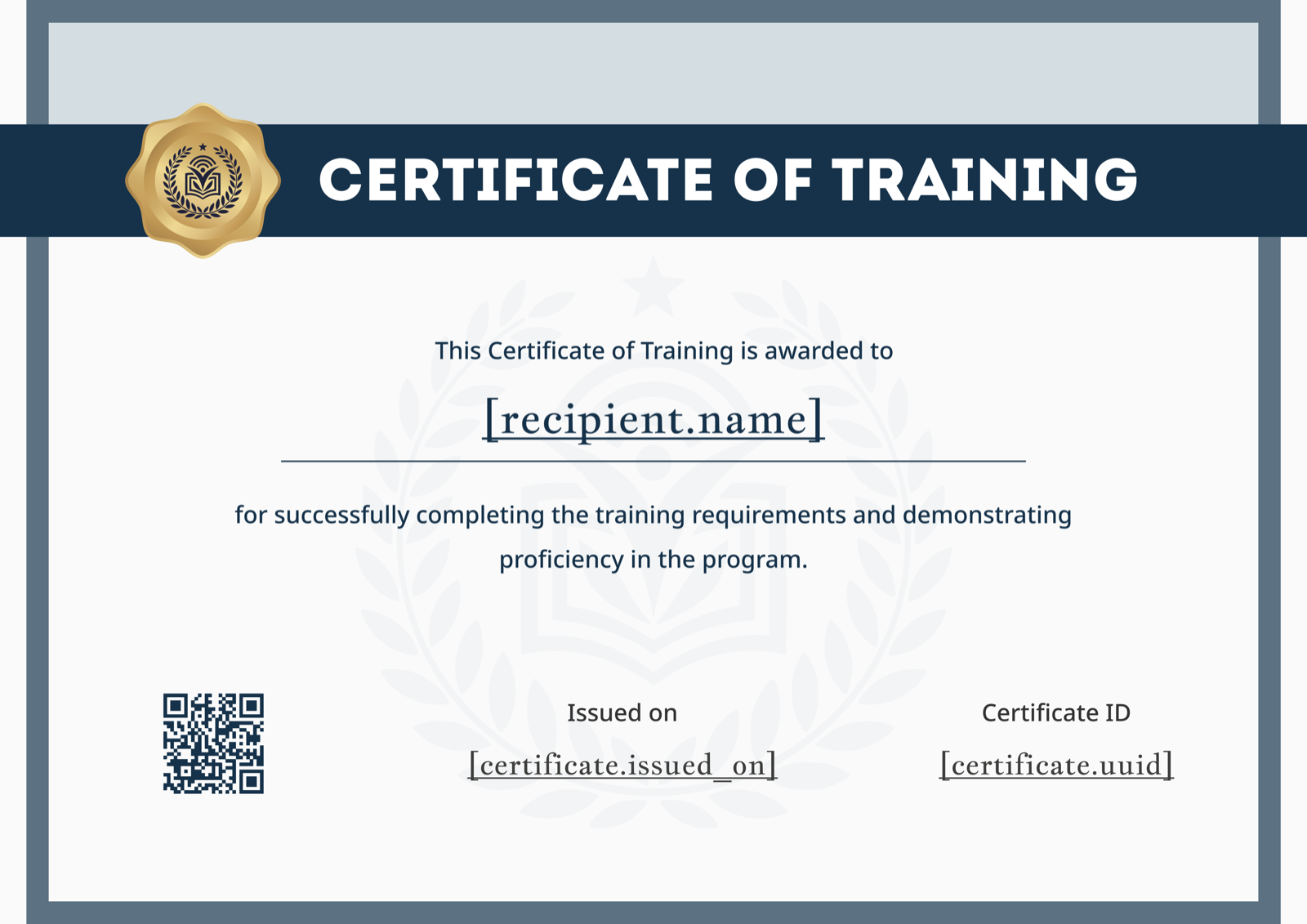
The navy header band gives the certificate visual weight before the recipient reads a word, and the gold medallion seal carries the authority that compliance documents need. Best for formal programs where leadership signs off — annual ethics training, executive onboarding, regulated industry refreshers. Browse it in the Certificate of Training gallery.
Emergency First Aid Training Certificate Template
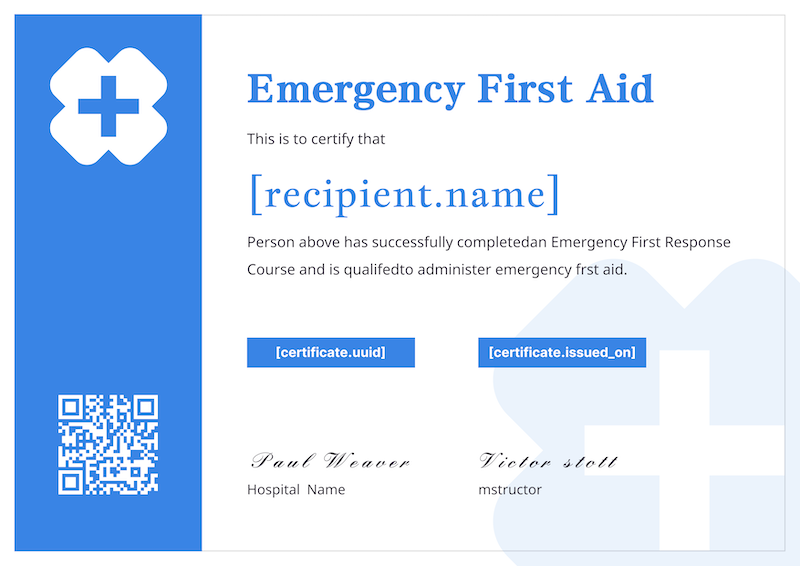
This one builds in a QR code verification block — useful for first aid, CPR, and bloodborne pathogens training where the recipient may be asked to prove the certificate is genuine. The medical cross and clean blue layout fit clinical settings without looking generic. Strong pick for healthcare HR teams issuing recurring annual training.
Blue Modern Wave Training Certificate

The bold typography handles long course titles ("Advanced Cybersecurity Awareness for Engineering Staff") without crowding, and the wave accent reads as modern rather than ceremonial. Good fit for tech companies, professional services, and any internal training where the recipient is more likely to add it to LinkedIn than frame it.
Luxury Black and Gold Training Certificate Template

The dark background and ornate gold border give the document the gravity that high-stakes safety training calls for — OSHA programs, hazmat handling, machinery operator licensing. Use it when the training has real consequences for getting it wrong, and you want the certificate to feel like it earned its place in the personnel file.
For more options sorted by industry and style, see our roundup of the best free Certificate of Training templates.
Issuing: One-Off vs At Scale
For a single employee or a small team — say, fewer than ten certificates — manual editing in Word or Figma works fine. Open the template, replace the placeholder fields, export to PDF, send. Our step-by-step guide to creating a certificate walks through it. If you need physical copies for the personnel file, the printing guide covers paper, bleed, and DPI.
At scale — quarterly compliance refreshers, large onboarding cohorts, multi-site safety rollouts — manual editing breaks down fast. CertFusion connects to your training data source (Google Forms, Typeform, Tally, Zoom attendance, or webhook) and generates personalized certificates automatically with the right course code, duration, and expiry per recipient. For employee training specifically, the value is that expiries get tracked centrally — when March 2027 comes around for those HIPAA certificates, you know exactly who needs to retake the training.
Tracking Expiries and Recertification Windows
This is the field that separates Certificate of Training from every other type. Most workplace training expires — OSHA forklift recertification at three years, annual HIPAA training, biennial bloodborne pathogens, varying CPR cycles by certifying body. The certificate's expiry date isn't decoration; it's an operational deadline.
The hard part isn't issuing the certificate. It's knowing, six months later, that 23 of your 200 warehouse staff are within 90 days of expiry and need to be scheduled. Spreadsheets work until headcount crosses about 50 people, then the manual tracking starts dropping people. Whatever system you use — a tracking column in your HRIS, a dedicated compliance tool, or automated certificate platform with built-in expiry alerts — the certificate's expiry date has to flow into something that actively pings you. Otherwise, the audit finds the lapses before you do.
Pick a layout from the Certificate of Training template gallery, get the wording right the first time, and build the expiry tracking before the issuing — because the certificate you generate today is the renewal you'll need to chase in 2028.
Table of Contents
Related Articles
Discover more insights and stories that might interest you